Flexibility Market Rules Framework
Document Summary
This document describes the Flexibility Market Rules Framework and details what a Flexibility Market Rule is, what formats it can take and how this creates a coordinated market.
The Publish Date and Implementation Date form part of the legal baseline for this Governance Document and shall be taken as the effective dates for the purposes of interpretation and version control.
In the event of any discrepancy between the dates stated above and those referenced in any accompanying publication, metadata, or communication, the dates recorded in this Governance Document shall prevail.
For the avoidance of doubt, the Implementation Date represents the date on which the obligations, rights, and procedures set out in this Governance Document take operational effect.
The purpose of the Flexibility Market Rules Framework is to:
Deliver a robust framework for defining, documenting, and accessing Flexibility Market Rules.
Provide sufficient detail to capture and align the various requirements of well-functioning, coordinated markets whilst also being clear, concise, and accessible to stakeholders.
Ensure that Flexibility Market Rules are as usable and scalable as possible.
The framework includes:
What a Flexibility Market Rule is.
What format a Flexibility Market Rule can take to ensure it delivers the right technical and contextual information.
How it ties together to create a clear and coordinated market.
How we record and share the Flexibility Market Rules to ensure that everyone is clear on what is required of them.
The framework does not set out which Flexibility Market Rules will be created (these will be defined through the Delivery Plan, established as per FGD-DPP), how they are updated (the Change Management Procedure, as set out in FGD-CMP), or how we monitor implementation (the Implementation Monitoring process, as set out in FGD-IMP). Instead, it focuses on how the rules are presented and coordinated.
Flexibility Market Rules are the backbone of the Market Facilitator’s enduring value proposition. These rules are essential for delivering consistent, accessible and interoperable Flexibility Markets and are core to the ‘Market Coordination’ function, as set out in Ofgem’s “Market Facilitator Governance Framework Document”. The Flexibility Market Rules Framework describes how the rules will be structured. This includes framing the characteristics of a rule, as well as how they all fit together, to drive a cohesive market design.
The rules define the common rules, market processes, services and standards that underpin efficient market coordination. System Operators will be licence-bound to adhere to the Flexibility Market Rules.
Flexibility Market Rules must be in line with the remit and scope of the Market Facilitator as set out be Ofgem in their Governance Framework Document.
Flexibility Market Rules will take many different formats, from market processes to API definitions and data schemas. These will document the core market requirements to be adhered to by System Operators.
The rule will concisely and accurately define the requirements for the relevant System Operators. These can take on multiple formats and will be published on the Elexon website. This will lean on digital best practice to ensure ease of use at scale and will evolve and adapt to stakeholder requirements.
Alongside the core ‘rule’, each Flexibility Market Rule will be structured to provide key contextual information, including, but not limited to:
Why? A clear articulation of the purpose and expected benefit of the Flexibility Market Rule.
How? Clarity on the implementation requirements (e.g., how the Flexibility Market Rule should be used and whether variations are allowed, when implementation is considered complete, and the associated data to be collected to monitor the implementation of the rule).
Who? Identification of impacted stakeholders.
When? A defined implementation timeline.
How will we know it is working? A structured approach to monitoring implementation and assessing whether the Flexibility Market Rule is delivering its intended benefits.
Version history, change log and key assumptions and dependencies to track updates and interdependencies.
A simplified summary in Plain English, where possible, to aid accessibility.
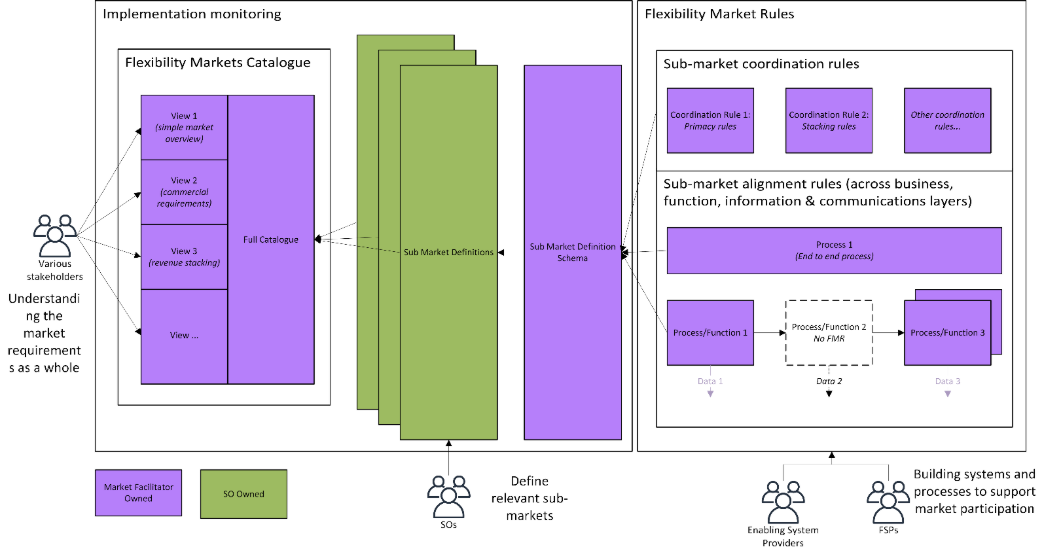
Given the breadth of Flexibility Market Rules, both in terms of scope and format, we need a structured approach to their framing. To provide the required top-down overview and bottom-up details of the rules, the Flexibility Market Rules framework will be layered.
This layering is summarised in Figure 1 below:

Figure 1: Framework outlining the key parts of Flexibility Market Rules and Implementation Monitoring
The Flexibility Market Rules will be split into two categories:
Sub-Market Alignment Rules, focused on aligning elements across Sub-Markets. For example, this might include metering specifications, settlement methodologies.
Sub-Market Coordination Rules, which govern how Sub-Markets interact, support revenue stacking and ensure consistency in how Sub-Markets work together.
The Sub-Market Alignment Rules will detail specific requirements for alignment. They are focused on driving alignment across markets and defining individual components.
The Sub-Market Alignment Rules will range in style and format depending on the core content. These may include, but are not limited to:
A process (such as an end-to-end process for flexibility services),
Common methodologies (such as baselining or settlement methodologies),
A data schema (such as pre-qualification criteria),
Documents (such as the standard legal agreement) ...
The Sub-Market Coordination Rules will set out how Sub-Markets interact, including how participants can participate across markets and how System Operators coordinate their interactions.
A common glossary across the Flexibility Market Rules shall be created. It shall be a Flexibility Market Rule itself, to ensure it has the legal basis for applicability within the other rules and is covered by the change management process.
A master list of definitions can be found in the Market Facilitator Glossary.
The following definitions are specific to this Governance Document. These are supplemented by the definitions in the Market Facilitator Glossary. If there is an inconsistency between definitions, the definition in this document shall prevail.
FGD: Flexibility Market Rules Framework - Amendment record
Annex 1: Associated meta-data
Register / log in for extra features
Save documents and get notified when they change, access AI overviews in search.
1.1
The Publish Date and the Implementation Date for this Governance Document are as follows:
Term
Date
Publish Date
12 December 2025
Implementation Date
12 December 2025