This section is provided as guidance to the Flexibility Market Rule. Therefore, it is not legally binding and falls outside of the formal change management process.
Context
The Verification & Settlement of flexibility services involves assessing the performance of providers and determining how much they should get paid. This rule establishes a standardised process and methodology for that process to reduce complexity and increase consistency in the payments received for FSPs. The rule comes into force in February 2026 across DNO sub-markets.
Verification & Settlement Requirements
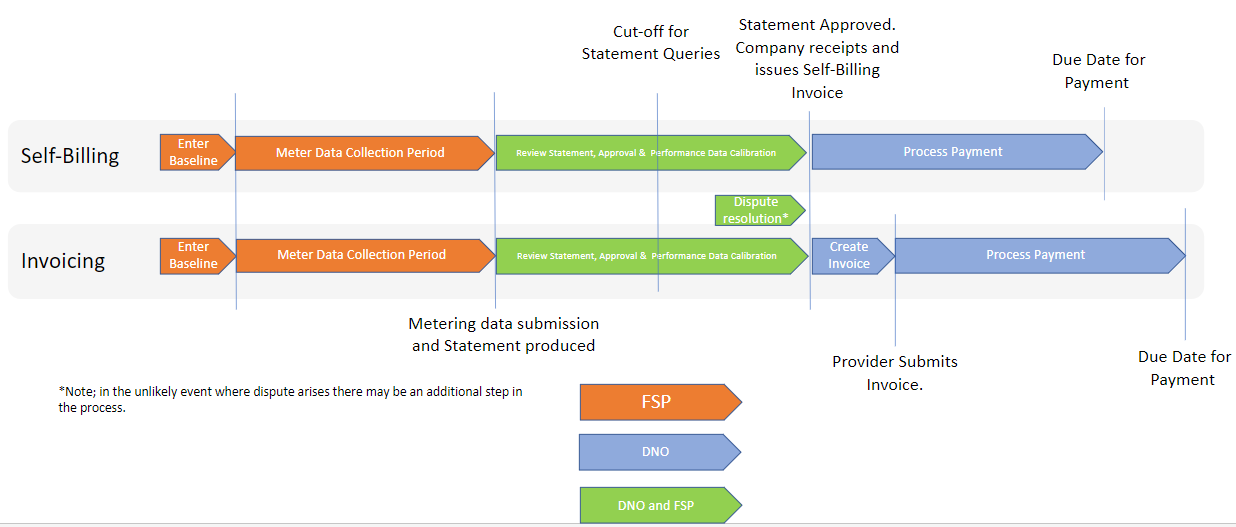
The rule sets out a monthly cycle to which DNOs must operate their verification and settlement processes.
It also sets out an aligned methodology for assessing delivery and common factors to be used, and a sign convention for the calculations. For utilisation, this is based on a clawback of payment for under-delivery (below an agreed grace factor). Where availability payments are due, performance across the utilisation events is used to determine payment.
Finally, the rule sets out requirements on the information that DNOs must provide to FSPs to provide feedback on performance.
Alongside the standard implementation tracking, DNOs must also report on whether they use any non-standard figures, and formulae. The number of variations will be tracked by the Market Facilitator.
We believe the impact of these requirements to be:
Impact on System Operators | Impact on FSPs |
|---|
System Operators must use the standardised methodology to assess performance and calculate performance. They must ensure their systems use the sign convention set out, and provide FSPs with the relevant information to understand their payments. | FSPs should understand the methodology as it determines the System Operators view of successful delivery, and ultimately their payment. |
Implementation monitoring requirements
The key requirements are laid out below. A view across the rules is available in our deadline tracker.
Category | Requirement | Trigger for data submission | What we will do with it |
|---|
Implementation tracking | Basic tracking of implementation status and target date | From 14/01/2026 (20 working days after the published date). Within 10 days of change | Track whether implementation is on track via our Implementation tracker. |
Flexibility Market Catalogue data | Confirmation of use of standard or non-standard methodology | From 06/02/2026. Within 10 days of change | Provide an overview of the sub-market and the market as a whole via the Flexibility Market Catalogue. |
Effectiveness monitoring data | - | - | - |
Derogations against this Rule
The following derogations are in place:
Who | What | For how long | Why |
|---|
UKPN | Section 2.3 and Section 2.4 | Until 31/07/2026 | To allow for
comprehensive implementation |
SSEN | The full requirements for LMA Interim Payment Service | Until 01/02/2027 | To prevent blockers to
LMA Interim Service settlement |
NPg | The full requirements for Empower Flex product | Until 31/03/2027 | To prevent blockers to Empower
Flex product settlement |
0.0
Sections 1, 2, 3 and 4 form the legally binding Flexibility Market Rule.
Defined terms capitalised in this document shall have the meaning given in Section 4.